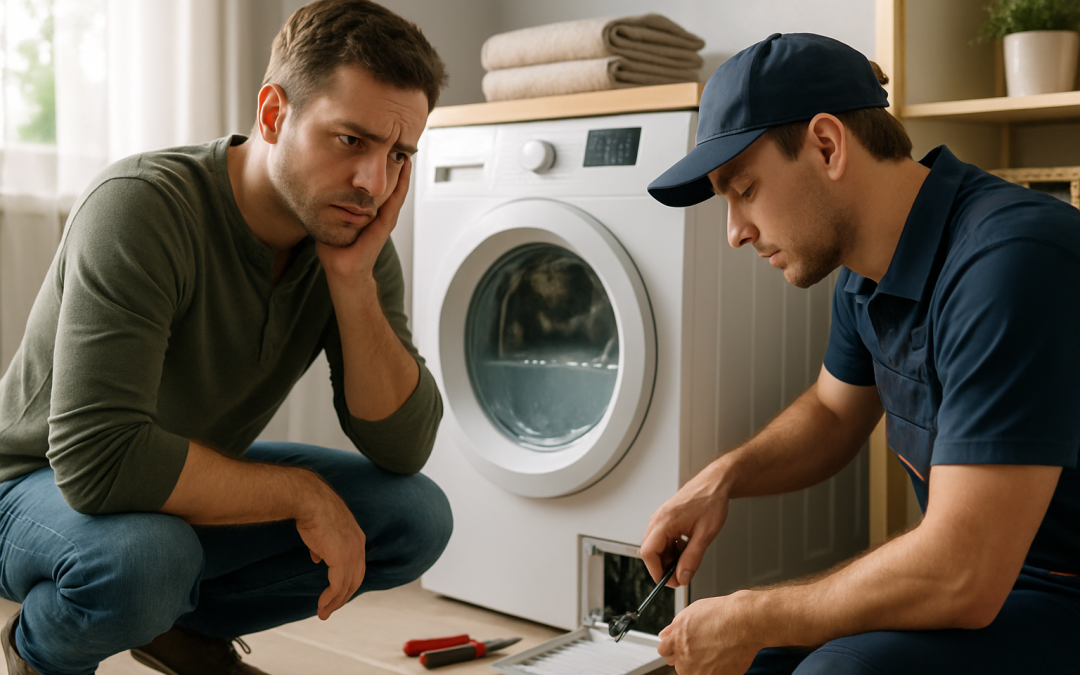
When a washer is not draining water, it usually means something is blocking the drain system, the pump is not working correctly, or the machine has detected a problem and stopped mid-cycle. In many cases, you can safely check for simple issues like a clogged drain hose, a kinked hose, or a blocked filter. More serious problems, such as a failed drain pump or control board issue, usually require a professional technician. Because different brands and models behave differently, you may not know the exact cause until some basic troubleshooting is done.
If your washing machine is full of water and will not drain, it can be stressful and inconvenient. This guide is for homeowners and renters who want to understand what is happening, what they can safely check themselves, and when it is time to call a repair technician. By the end, you should have a clear idea of the likely causes, repair costs, and whether repair or replacement makes more sense for your situation.
Table of Contents
- What “Washer Not Draining Water” Usually Means
- Common Causes of a Washer Not Draining
- What to Check First (Safe, Simple Steps)
- Common Washer Error Codes Related to Draining Problems
- When the Problem Is Serious
- When to Call a Professional Technician
- Washer Drain Repair Cost Expectations
- Washer Not Draining: Repair vs. Replace
- Prevention Tips to Avoid Drain Problems
- Safety Risks and What to Avoid
- Frequently Asked Questions
- Summary: What to Do Next
- Need Help? Next Steps
What “Washer Not Draining Water” Usually Means
When a washer will not drain, it means the machine cannot move water out of the tub and into the home’s drain line. This can happen at the end of the wash cycle, during the rinse, or before the spin cycle starts.
Typical signs include:
- Clothes sitting in a pool of water at the bottom of the drum
- Washer stopping mid-cycle and not moving to spin
- Gurgling or humming sounds but no water movement
- Error codes or flashing lights on the control panel
In most cases, the problem is in one of three areas:
- The drain path (hose, standpipe, or filter) is blocked or kinked
- The drain pump is clogged or has failed
- The control system or sensors are preventing the washer from draining
Common Causes of a Washer Not Draining
1. Clogged or Kinked Drain Hose
The drain hose carries water from the washer to your home’s drain. If it is blocked or bent, water cannot flow out properly.
- Hose pushed too far into the standpipe, causing a restriction
- Hose kinked or crushed behind the washer
- Debris, lint, or small clothing items stuck in the hose
2. Clogged Drain Pump Filter or Coin Trap
Many front-load washers and some top-load models have a filter or “coin trap” before the pump. This catches small objects but can become clogged over time.
- Coins, hairpins, buttons, and small socks blocking the filter
- Heavy lint buildup slowing water flow
- Foreign objects jamming the pump impeller
3. Failed or Weak Drain Pump
The drain pump is an electric motor that pushes water out of the washer. If it fails, the washer may hum, buzz, or do nothing at all when it should be draining.
- Burned-out pump motor
- Impeller (small fan-like part) broken or loose
- Intermittent pump that works sometimes and fails other times
4. Lid Switch or Door Lock Problems (Top-Load and Front-Load)
Washers often will not spin or drain if they think the lid or door is open. A faulty lid switch or door lock can stop the drain cycle for safety reasons.
- Top-load washer not recognizing that the lid is closed
- Front-load washer door lock light flashing or not engaging
- Washer pausing and never moving to drain or spin
5. Control Board or Timer Issues
The control board (or mechanical timer on older models) tells the washer when to drain. If it fails, the machine may get “stuck” before the drain step.
- Cycle stops at the same point every time
- No power sent to the drain pump even though the tub is full
- Random error codes or unresponsive controls
6. Drain Standpipe or House Plumbing Blockage
Sometimes the washer is trying to drain, but the home’s drain line is blocked. This can cause water to back up and overflow.
- Water overflowing from the standpipe or laundry sink
- Slow draining in nearby sinks or tubs
- Gurgling sounds from the drain when the washer runs
7. Oversudsing from Too Much Detergent
Using too much detergent, or the wrong type, can create excess suds that confuse the washer’s sensors and slow draining.
- Lots of foam visible in the drum or door glass
- Washer extending the cycle or stopping with an error
- Particularly common in high-efficiency (HE) front-load washers
8. Unbalanced or Overloaded Washer
If the washer is overloaded or the load is badly unbalanced, it may not spin properly. Without a proper spin, water stays in the clothes and drum.
- Heavy items like blankets or rugs bunched on one side
- Washer repeatedly trying to balance the load and then stopping
- Very wet clothes at the end of the cycle
What to Check First (Safe, Simple Steps)
Before you do anything, always:
- Unplug the washer from the wall outlet
- Turn off the water supply valves if you need to move the machine
1. Confirm the Symptoms
- Is the tub full of water, partially full, or empty but clothes are very wet?
- Do you hear the pump running (a humming or whirring sound) when it should be draining?
- Is there an error code on the display?
2. Check the Drain Hose for Kinks or Obvious Blockages
- Gently pull the washer away from the wall a few inches.
- Look for sharp bends, kinks, or crushed sections in the drain hose.
- Make sure the hose is not pushed too far down into the standpipe (usually 4–6 inches is enough).
If you see a kink, straighten it and try a drain or spin cycle again.
3. Inspect the Drain Standpipe or Laundry Sink
- Check if water is backing up or overflowing when the washer tries to drain.
- If the standpipe or sink is overflowing, the problem may be in your home’s plumbing, not the washer.
- In that case, a plumber may be needed to clear the drain line.
4. Try a “Drain and Spin” or “Spin Only” Cycle
- Many washers have a separate drain or spin cycle.
- Select that option and see if the washer attempts to drain.
- Listen for the pump: if you hear it but no water moves, there may be a blockage; if you hear nothing, the pump may not be getting power or may have failed.
5. Check for Oversudsing or Overloading
- If you see lots of suds, run an extra rinse and use less detergent next time (and only HE detergent in HE machines).
- If the load is very heavy or unbalanced, remove some items and try the spin cycle again.
6. Access the Drain Filter (If Easily Accessible)
Many front-load washers have a small access door at the front bottom for the drain filter. If your model has this and the manufacturer’s manual shows how to open it safely, you may:
- Place towels and a shallow pan under the access door (water may spill out).
- Carefully open the filter cap and let water drain slowly.
- Remove visible debris like coins, hairpins, or lint.
If the filter is hard to reach, requires removing panels, or you are unsure, it is safer to call a technician rather than risk a leak or damage.
Common Washer Error Codes Related to Draining Problems
Different brands use different codes, but many washers display specific errors when they cannot drain. Always check your user manual for exact meanings, but here are common patterns:
Front-Load Washers
- “OE”, “E1”, “E2”, “ND”, “F9E1”, “F21” (varies by brand) – Often indicate a drain problem or long drain time.
- “SD” or “SUD” – Usually means oversudsing; too much detergent can slow or stop draining.
- “DE”, “DL”, “dL” – Door lock errors that can prevent the washer from draining or spinning.
Top-Load Washers
- “LD”, “ND”, “F9E1” – Long drain or no drain detected.
- “LID”, “LID LOCK” – Lid switch or lid lock issue that can stop the drain/spin cycle.
If your washer shows a drain-related error code and basic checks do not solve it, a professional diagnosis is usually the fastest and safest option.
When the Problem Is Serious
The issue is more serious and likely needs professional attention if:
- The washer repeatedly stops with the same drain error code, even after checking the hose and filter.
- You hear a loud grinding, rattling, or burning smell when the washer tries to drain.
- Water leaks from under the washer during or after the drain cycle.
- The pump does not run at all (no sound) when the washer should be draining.
- There are signs of electrical issues, like tripped breakers or flickering lights when the washer runs.
These symptoms often point to a failed drain pump, damaged wiring, or a control board problem, which are not safe DIY repairs for most homeowners.
When to Call a Professional Technician
Call a qualified appliance repair technician when:
- Basic checks (hose, standpipe, simple filter access) do not fix the problem.
- You are not comfortable opening panels or dealing with water inside the machine.
- The washer is under warranty or extended protection plan (DIY repairs can void coverage).
- You suspect a failed pump, control board, or wiring issue.
- The washer is leaking, tripping breakers, or showing repeated error codes.
A professional can safely test electrical components, remove internal clogs, and replace parts without damaging the machine or creating a safety hazard. If you have other appliances acting up, such as a Bosch dishwasher that is not draining or a Samsung dryer that is not heating, it can be efficient to have a technician look at multiple units in one visit.
Washer Drain Repair Cost Expectations
Actual costs vary by location, brand, and the exact problem, but these ranges are typical:
- Service call / diagnostic fee: $75–$150
- Minor repair: $75–$200 (simple clog removal, hose adjustment, basic filter cleaning if done by a pro)
- Moderate repair: $150–$400 (drain pump replacement, lid switch or door lock replacement, more involved clog removal)
- Major repair: $400–$800+ (control board replacement, multiple parts, or extensive labor on high-end models)
What Affects the Cost
- Brand and model: High-end or European brands often have more expensive parts.
- Age of the washer: Older models may require harder-to-find parts or extra labor.
- Type of problem: Simple clogs are cheaper; electrical or control board issues cost more.
- Access and installation: Stackable units or tight laundry closets can increase labor time.
When Costs Increase
- If the pump, control board, and other components are damaged by a long-term leak or electrical issue.
- If the technician has to disassemble large portions of the machine to reach the problem.
- If multiple visits are needed to diagnose intermittent issues.
As a rough guideline, if the repair estimate is more than 50% of the cost of a new washer, it is worth carefully considering replacement instead of repair.
Washer Not Draining: Repair vs. Replace
Deciding whether to repair or replace a washer that is not draining depends on age, condition, and repair cost.
When Repair Usually Makes Sense
- The washer is less than 7–8 years old.
- The problem is a simple clog, hose issue, or drain pump replacement.
- The total repair cost is under about $300–$400.
- The washer has otherwise been reliable and meets your needs.
When Replacement May Be the Better Option
- The washer is 10+ years old and out of warranty.
- There are multiple issues (drain problem plus noise, leaks, or spin problems).
- The repair quote is more than 50% of the price of a comparable new washer.
- Parts are discontinued or very expensive for your specific model.
Other Factors to Consider
- Energy and water efficiency: Newer washers often use less water and electricity, which can lower utility bills.
- Matching set: If your dryer is also old, you may choose to replace both for a matching, efficient set.
- Time and convenience: If you rely heavily on your washer, a quick replacement may be more convenient than waiting on parts.
Prevention Tips to Avoid Drain Problems
While not every issue can be prevented, good habits can reduce the chance of your washer failing to drain.
1. Use the Right Detergent and Amount
- Use only HE detergent in high-efficiency washers.
- Follow the detergent manufacturer’s measuring guidelines; more is not better.
- Reduce detergent if you have soft water or small loads.
2. Check Pockets Before Washing
- Remove coins, keys, hairpins, screws, and other small objects.
- These items can clog the filter, damage the pump, or get stuck in the drain hose.
3. Avoid Overloading the Washer
- Leave some space at the top of the drum for clothes to move freely.
- Wash heavy items like blankets or rugs separately and follow the manual’s guidance.
4. Periodically Clean the Drain Filter (If Accessible)
- If your washer has a user-accessible filter, clean it every few months or as recommended in the manual.
- Always unplug the washer and be prepared for some water to drain out.
5. Keep the Drain Hose Properly Positioned
- Ensure the hose is not kinked or crushed behind the washer.
- Confirm the hose height and insertion depth into the standpipe match the manufacturer’s instructions.
Safety Risks and What to Avoid
Working around water and electricity can be dangerous. Keep these safety points in mind:
- Always unplug the washer before inspecting hoses, filters, or internal parts.
- Do not reach into standing water inside the washer if you suspect an electrical problem.
- Avoid opening internal panels or handling wiring unless you are trained and qualified.
- Do not bypass safety devices like lid switches or door locks; they are there to protect you.
- If you smell burning, see smoke, or the breaker keeps tripping, stop using the washer and call a professional immediately.
For other appliances that involve heat or high voltage, such as a gas oven that is not heating or a microwave that is not heating, professional service is especially important for safety.
Frequently Asked Questions
Why is my washer not draining but spinning?
If your washer spins but does not fully drain, there may be a partial blockage in the drain hose or filter that slows water flow. The spin cycle can still run, but water remains in the tub or clothes. Checking the hose for kinks and cleaning an accessible filter often helps, but persistent issues may require a technician.
Can I manually drain my washing machine?
Yes, many washers can be manually drained by using the drain hose or an accessible drain filter at the front bottom of the machine. Place towels and a shallow container under the hose or filter, then slowly release the water. If you are unsure how to do this safely, or if the washer is in a tight space, it is safer to call a professional.
Is it safe to keep using a washer that does not drain properly?
Continuing to use a washer that does not drain can lead to leaks, mold growth, and damage to the motor or control board. It can also strain your home’s plumbing if water backs up. It is best to stop using the machine until the cause is found and fixed.
How do I know if the drain pump is bad?
Common signs of a bad drain pump include loud grinding or rattling noises, a humming sound with no water movement, or no sound at all when the washer should be draining. Because testing the pump involves electricity and sometimes disassembly, a technician is usually needed to confirm and replace a failed pump.
Why does my washer show a drain error code sometimes but work other times?
Intermittent drain errors can be caused by partial clogs, a weak pump, or loose wiring that only fails under certain conditions. The washer may drain fine with small loads but struggle with larger ones. A professional diagnosis can help catch these issues before they turn into a complete failure.
How long should a washing machine last?
Most washers last around 8–12 years, depending on brand, usage, and maintenance. If your machine is within this range and has its first major problem, a repair may still make sense; if it is older and has multiple issues, replacement may be more cost-effective.
Summary: What to Do Next
A washer not draining water usually points to a clog, a hose problem, or a failing drain pump. Start with safe checks: inspect the drain hose, look for plumbing backups, try a drain/spin cycle, and clean any easily accessible filter. If the washer still will not drain, shows repeated error codes, or makes unusual noises, the problem is likely more serious and needs professional attention. Weigh the repair cost against the age and condition of your washer to decide whether to repair or replace.
Need Help? Next Steps
If your washer is still full of water or keeps stopping with a drain error, do not force it to run or attempt risky DIY repairs. A qualified appliance repair technician can quickly identify whether you are dealing with a simple clog or a more complex pump or control issue. Schedule a service visit to protect your home from leaks, avoid electrical hazards, and get your laundry routine back to normal as safely and efficiently as possible.