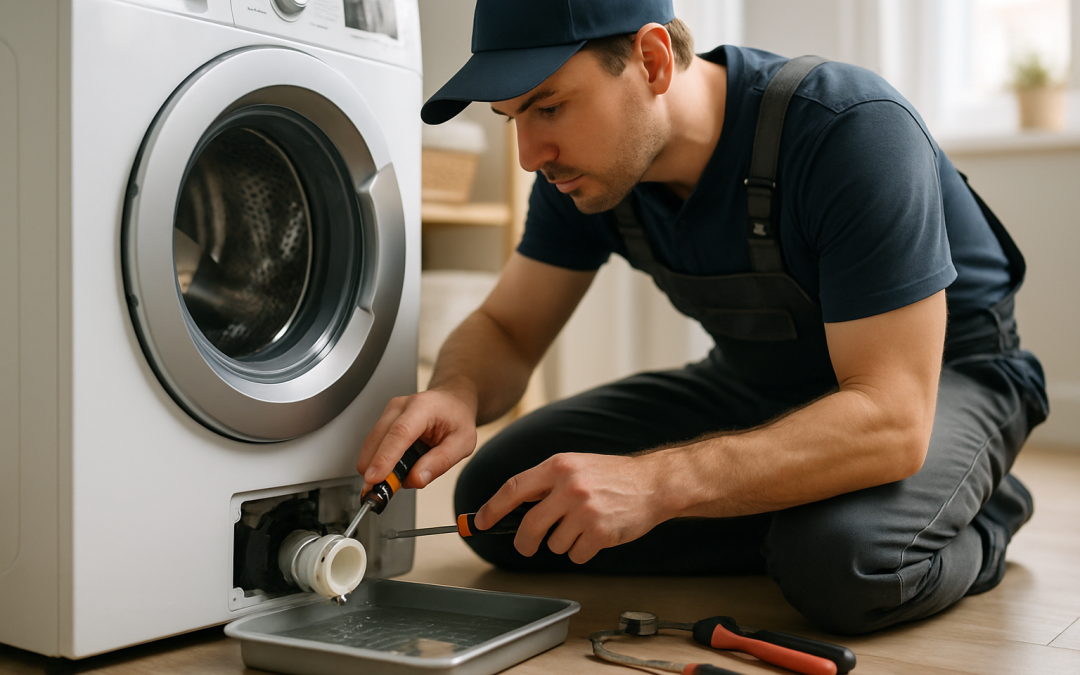
Washer Drain Pump Problems: Symptoms, Causes, Fixes, and When to Replace It
Washer drain pump problems usually show up as water left in the drum, loud grinding or humming noises during drain or spin, or error codes related to draining. In many cases, the issue is a simple clog in the filter, hose, or pump area that a homeowner can safely check. However, if the pump motor itself has failed or is leaking, it typically requires a professional repair or replacement. Because symptoms can overlap with other issues, it’s not always possible to confirm a bad drain pump without proper testing.
When your washer will not drain or makes strange noises, it quickly becomes more than an inconvenience—it can mean leaks, damaged floors, or a machine that stops mid-cycle. This guide is for homeowners and renters who want to understand what a washer drain pump does, how to recognize problems, and what to do next. You’ll learn what you can safely check yourself, when to call a technician, and how to decide if repair or replacement makes the most sense.
Table of Contents
- What Washer Drain Pump Problems Mean
- Common Symptoms of Washer Drain Pump Problems
- Common Causes of Washer Drain Pump Issues
- What to Check First (Safe, Simple Steps)
- When the Problem Is Serious
- When to Call a Professional for Washer Drain Pump Repair
- Washer Drain Pump Repair Cost Expectations
- Washer Drain Pump Repair vs. Replacing the Washer
- Prevention Tips to Avoid Future Drain Pump Problems
- Safety Risks of a Failing Washer Drain Pump
- Frequently Asked Questions
- Summary: What to Do Next
What Washer Drain Pump Problems Mean
The drain pump is the part of your washer that pushes dirty water out of the tub and into the drain hose and household plumbing. When it isn’t working properly, the machine can’t remove water, which stops the cycle and can trigger error codes.
In practical terms, drain pump problems usually mean:
- Water remains in the drum after the cycle ends
- The washer stops mid-cycle and won’t continue
- You hear unusual noises when the washer tries to drain
- The washer shows a “drain” or “pump” error code
Sometimes the pump itself is fine, and the real issue is a clog in the filter, hose, or drain line. Other times, the pump motor is worn out, seized, or leaking and needs to be replaced.
Common Symptoms of Washer Drain Pump Problems
Washer Not Draining Water
The most obvious sign of a drain pump issue is standing water in the drum after the cycle should be finished. Clothes may be soaking wet, and the door on a front-loader may stay locked because the washer “thinks” there is still water inside.
If your main symptom is a washer that will not drain, you may also find it helpful to review broader draining issues in this detailed guide on washers not draining water.
Loud Noises During Drain or Spin
Drain pumps normally make a low humming or whooshing sound. Problem sounds include:
- Grinding or rattling (often from coins, buttons, or debris in the pump)
- Loud buzzing or humming with no water movement (motor stuck or jammed)
- High-pitched squealing (worn or failing internal parts)
Error Codes Related to Draining
Many modern washers show error codes when they detect a drain problem. Common codes (varies by brand) include:
- “ND” or “NO DRAIN”
- “OE,” “E1,” “F9E1,” or similar drain-related codes
- Flashing lights or beeps when the washer tries to drain
The code alone doesn’t prove the pump is bad, but it does confirm the washer is struggling to remove water.
Water Leaking from the Bottom Front of the Washer
A failing drain pump or its seals can leak during the drain portion of the cycle. You may notice:
- Water pooling under the front of the washer
- Drips or rust marks near the pump area (usually low and toward the front on many front-loaders)
- Leaks that only appear when the washer is draining or spinning
Washer Stops Mid-Cycle and Won’t Continue
If the washer cannot drain, it often pauses and refuses to move to the next step. You might see:
- Cycle stuck on “drain” or “spin”
- Washer turning off with water still inside
- Repeated attempts to drain with no success
Common Causes of Washer Drain Pump Issues
Clogged Drain Pump Filter or Trap
Many washers, especially front-load models, have a small filter or trap before the pump. It catches:
- Coins, hairpins, and small objects
- Lint and fabric threads
- Buttons, screws, and other debris
When this filter is clogged, the pump struggles to move water, which can cause slow draining, error codes, or loud noises.
Foreign Objects Inside the Pump
Items that slip past the filter can get into the pump itself. Common culprits include:
- Coins and small metal parts
- Broken pieces of plastic or zippers
- Heavy lint clumps or fabric strings
These can jam the impeller (the small fan-like part inside the pump), causing grinding noises, poor draining, or a seized motor.
Worn or Failed Pump Motor
Over time, the pump motor can simply wear out. Signs of a failing motor include:
- Loud humming with no water movement
- Intermittent draining that gets worse over time
- Washer only drains if you restart or reset it repeatedly
In these cases, cleaning clogs will not fix the problem; the pump usually needs to be replaced.
Damaged or Cracked Pump Housing
The plastic body of the pump can crack due to age, impact, or freezing temperatures. This often leads to:
- Leaks during the drain cycle
- Visible water under the washer
- Rust or mineral buildup around the pump area
Blocked Drain Hose or Standpipe
Sometimes the pump is fine, but the water has nowhere to go. Common issues include:
- Drain hose kinked or crushed behind the washer
- Clogged drain hose (lint, debris, or buildup)
- Household drain (standpipe) clogged or slow
These problems can mimic a bad pump because the washer still cannot drain properly.
Electrical or Control Board Problems
Less commonly, the pump itself is okay, but it is not getting the right power signal. This can be due to:
- Loose wiring connections to the pump
- Damaged harness or burned connectors
- Control board faults that fail to power the pump
Diagnosing these issues safely usually requires a trained technician and proper tools.
What to Check First (Safe, Simple Steps)
Before assuming the drain pump is bad, there are a few safe checks most homeowners can do without opening up electrical components.
1. Confirm the Symptom
- Run a “drain and spin” or similar cycle with no clothes.
- Listen for the pump: do you hear it running, humming, or grinding?
- Watch the drain hose at the back: is water flowing out or not?
2. Check the Drain Hose
- Make sure the hose is not kinked, crushed, or bent sharply behind the washer.
- Confirm the hose is inserted correctly into the household drain (standpipe or sink).
- If safe and accessible, you can gently remove the hose from the standpipe and see if water flows when the washer tries to drain (keep a bucket or towels ready).
3. Inspect and Clean the Drain Pump Filter (If Accessible)
Many front-load washers have a small access door near the bottom front that leads to a drain pump filter. If your model has this feature and the manual says it is user-serviceable, you can usually:
- Turn off and unplug the washer.
- Open the access door and place a shallow pan or towels underneath.
- Slowly open the filter cap to let water drain out.
- Remove and clean the filter, removing coins, lint, and debris.
Always follow your manufacturer’s instructions. If you are unsure or the filter is not clearly designed for user access, it is safer to call a professional.
4. Check for Household Drain Issues
- Make sure the standpipe or sink the washer drains into is not overflowing or backing up.
- If other fixtures (like sinks or tubs) are also draining slowly, you may have a plumbing issue rather than a washer problem.
5. Review Error Codes
If your washer shows an error code, look it up in the user manual or on the manufacturer’s website. Many codes clearly indicate a drain or pump issue. This can help you decide whether to try simple checks or move straight to a service call.
When the Problem Is Serious
Some signs suggest the drain pump or related parts are failing and should be addressed quickly:
- Repeated standing water in the drum even after you’ve checked the hose and filter
- Loud grinding, rattling, or buzzing from the pump area that does not go away
- Visible leaks from underneath the washer, especially during drain or spin
- Burning smell or signs of overheating when the washer tries to drain
- Tripped breaker or washer losing power when it reaches the drain cycle
These symptoms often mean the pump motor is damaged, the housing is cracked, or there is an electrical issue. Continuing to run the washer in this condition can lead to more damage or safety risks.
When to Call a Professional for Washer Drain Pump Repair
While basic checks are safe for most homeowners, many drain pump repairs involve electrical components, sharp edges, and water exposure. It is wise to call a professional when:
- You have cleaned the filter and checked the hose, but the washer still will not drain.
- The pump makes loud grinding, squealing, or buzzing noises.
- There is water leaking from the bottom of the washer.
- The washer shows persistent drain-related error codes.
- You are not comfortable tipping or opening the washer to access internal parts.
A qualified technician can test the pump, wiring, and control board safely, then advise whether a pump replacement or other repair is needed. This approach is similar to how professionals diagnose other appliance issues, such as a dishwasher that is not draining properly.
Washer Drain Pump Repair Cost Expectations
Understanding typical costs can help you decide whether to repair or replace your washer.
Service Call Fees
- Most appliance repair companies charge a service call or diagnostic fee of $75–$150.
- This usually covers the technician’s visit, basic diagnosis, and an estimate for the repair.
- Some companies apply this fee toward the repair if you proceed.
Drain Pump Repair and Replacement Costs
Actual costs vary by brand, model, and your location, but typical ranges are:
- Minor repair (clog removal, filter cleaning, hose adjustment): $75–$200
Often just the service call plus a small labor charge if no parts are needed. - Moderate repair (drain pump replacement): $150–$400
Includes the cost of the pump (commonly $50–$200) plus labor. - Major repair (pump plus additional parts or control issues): $400–$800+
Costs rise if the control board, wiring harness, or other components also need replacement.
What Affects the Cost
- Washer type: Front-load washers can be more labor-intensive to access the pump than some top-load models.
- Brand and model: Premium or less common brands may have more expensive parts.
- Age of the washer: Older models may require harder-to-find parts or extra labor.
- Local labor rates: Urban areas often have higher hourly rates than rural areas.
When Costs Increase
- If the pump has leaked and caused damage to other components.
- If the technician must remove major parts (like the tub or front panel) to access the pump.
- If multiple visits are needed due to special-order parts.
Washer Drain Pump Repair vs. Replacing the Washer
Deciding whether to repair or replace depends on the age, condition, and value of your washer, as well as the cost of the repair.
When Repair Usually Makes Sense
- Your washer is less than 7–8 years old and otherwise works well.
- The estimate for a drain pump replacement is in the $150–$300 range.
- You have not had frequent major repairs on this washer.
- You are satisfied with its features and efficiency.
When Replacement May Be the Better Option
- Your washer is 10+ years old and nearing the typical end of its life.
- The repair estimate is more than 50% of the cost of a new washer.
- There are multiple issues (for example, drain pump plus control board or bearings).
- You want a more efficient or larger-capacity model anyway.
As a general rule, if your washer is older and the repair is in the higher range (over $400), it is worth seriously considering replacement instead of putting more money into a machine that may soon have other problems.
Questions to Ask Your Technician
- Is the drain pump the only issue, or do you see signs of other upcoming problems?
- What is the total cost, including parts, labor, and tax?
- How long do you expect this repair to last on a washer of this age?
- Is there any warranty on the new pump and the labor?
Prevention Tips to Avoid Future Drain Pump Problems
While you cannot prevent every failure, good habits can reduce the risk of clogs and premature pump wear.
Use a Lint or Garment Bag for Small Items
- Wash small items (baby socks, lingerie, small accessories) in mesh laundry bags.
- This helps prevent them from slipping into the drain system.
Empty Pockets Before Washing
- Remove coins, keys, hairpins, screws, and other small objects.
- These are some of the most common causes of pump jams and noise.
Clean the Drain Pump Filter Regularly (If Your Model Has One)
- Check your manual for recommended cleaning intervals (often every 1–3 months).
- Regular cleaning helps prevent slow draining and pump strain.
Avoid Overloading the Washer
- Overloading can stress multiple components, including the pump.
- Follow the manufacturer’s guidelines for load size and weight.
Use the Right Detergent and Amount
- Use HE (high-efficiency) detergent in HE washers.
- Too much detergent can create excess suds and residue, which may contribute to buildup in hoses and drains.
Safety Risks of a Failing Washer Drain Pump
Ignoring drain pump problems can lead to more than just inconvenience.
Water Damage and Mold
- Leaks from a cracked pump or loose connections can damage floors, subfloors, and nearby cabinets.
- Standing water in the drum or under the washer can encourage mold and mildew growth.
Electrical Risks
- Water and electricity are a dangerous combination; leaks near electrical components can increase shock risk.
- A failing pump motor can overheat, potentially damaging wiring or tripping breakers.
Unstable Operation
- If the washer cannot drain properly, it may not spin correctly, leading to unbalanced loads and excessive vibration.
- Severe vibration can damage the washer or nearby structures over time.
For these reasons, it is important not to keep running a washer that clearly has a drain or pump problem.
Frequently Asked Questions
How do I know if my washer drain pump is bad or just clogged?
A clogged pump or filter often causes slow draining, standing water, and sometimes rattling from coins or debris. If you clean the filter and check the hose but the washer still will not drain, or the pump only hums loudly without moving water, the pump motor itself may be failing and should be checked by a technician.
Can I run my washer if the drain pump is making noise?
It is not a good idea to keep running a washer with a noisy drain pump. Grinding, squealing, or loud buzzing can mean something is stuck in the pump or the motor is failing, and continued use can cause more damage or lead to leaks.
Is it worth replacing a washer drain pump?
In many cases, yes—especially if the washer is under about 7–8 years old and otherwise in good condition. If the total repair cost is reasonable compared to the price of a new washer, replacing the pump can extend the life of your machine for several more years.
How much does it cost to replace a washer drain pump?
Most homeowners can expect a total cost in the range of $150–$400 for a drain pump replacement, including parts and labor. The exact price depends on your washer’s brand and model, local labor rates, and how difficult it is to access the pump.
Can I replace a washer drain pump myself?
Some experienced DIYers can replace a drain pump, but it usually involves tipping or opening the washer, disconnecting hoses and wiring, and working around water and electrical components. For most homeowners, it is safer and more reliable to have a qualified technician handle the repair.
Why does my washer show a drain error code but still spin?
Some washers can partially drain or spin even when there is a minor restriction or intermittent pump issue. The control board may detect that draining is slower than expected and trigger an error code, which is a sign that you should check the hose and filter and consider a professional diagnosis if the code keeps returning.
Summary: What to Do Next
Washer drain pump problems usually show up as standing water, loud noises during draining, leaks, or drain-related error codes. Sometimes the fix is as simple as clearing a clogged filter or straightening a kinked hose; other times, the pump motor or housing has failed and needs professional replacement.
If basic checks do not solve the problem, or you notice persistent noise, leaks, or burning smells, it is time to schedule a service visit. A technician can confirm whether a pump replacement is worthwhile based on your washer’s age, condition, and the total repair cost.
Addressing drain pump issues promptly can prevent water damage, mold, and more expensive repairs later. If you are unsure about any step or uncomfortable working around water and electrical parts, contact a qualified appliance repair technician rather than risking unsafe DIY work.