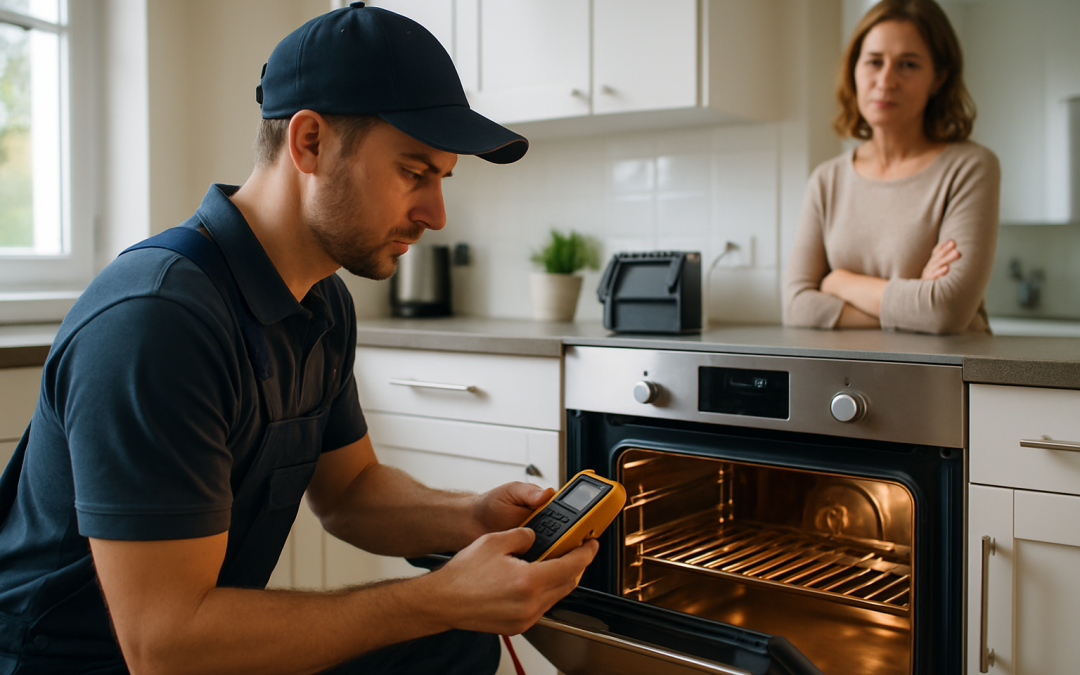
Professional oven repair service near you can quickly diagnose why your oven is not heating, cooking unevenly, or showing error codes, and then safely fix the problem. A technician will inspect the power or gas supply, test key components, and replace only what is necessary so you can get back to reliable cooking. Most repairs are completed in a single visit and cost less than replacing the appliance, but very old or severely damaged ovens may not be worth repairing. Exact pricing and repair options depend on your oven’s age, brand, and the specific part that has failed.
If your oven has stopped working, is burning food, or takes forever to preheat, you are not alone—these are some of the most common appliance problems homeowners face. This guide explains what might be happening, what you can safely check yourself, what professional oven repair includes, and how much you can expect to pay. It is written for homeowners and renters with little or no technical background who want clear, practical next steps. By the end, you will know whether to try a simple check, schedule a repair visit, or start thinking about replacement.
Table of Contents
- What a Local Oven Repair Service Actually Does
- Common Oven Problems and What They Mean
- What to Check First (Safe, Simple Steps)
- When the Problem Is Serious
- When to Call a Professional Oven Repair Technician
- Oven Repair Cost Expectations
- Oven Repair vs. Replacement: How to Decide
- Simple Oven Maintenance and Prevention Tips
- Oven Safety Risks You Should Not Ignore
- Frequently Asked Questions
- Summary and Next Steps
What a Local Oven Repair Service Actually Does
What “oven repair service near you” really means
When you schedule an oven repair service near you, a trained technician comes to your home to diagnose and fix problems with your electric or gas oven or range. They bring tools, testing equipment, and common replacement parts to handle most issues on the spot. The goal is to restore safe, reliable operation without you having to guess or take the appliance apart yourself.
Typical steps in a professional oven repair visit
While every company is different, most professional oven repair visits follow a similar process:
- Initial assessment: The technician asks about symptoms (no heat, uneven baking, error codes, strange smells, etc.).
- Safety check: They confirm the oven is properly connected to power or gas and that there are no immediate hazards.
- Diagnostic testing: Using meters and tools, they test components such as heating elements, igniters, thermostats, sensors, control boards, and wiring.
- Clear explanation: They explain what failed, why it failed, and what it will cost to fix, before doing the work.
- Repair and parts replacement: Faulty parts are removed and replaced, connections are secured, and the oven is reassembled.
- Final testing: The technician runs the oven through a heating cycle to confirm proper operation and checks for gas leaks on gas models.
What professional oven repair usually includes
A reputable oven repair service typically includes:
- Travel to your home and a full diagnostic of the oven problem
- Written or verbal estimate before any repair work
- Labor to remove and install parts
- Basic cleaning of the repair area and safe reassembly
- Testing for correct temperature and operation
- A short parts and/or labor warranty (varies by company)
Common Oven Problems and What They Mean
Oven not heating at all
This is one of the most common complaints. You set a temperature, but the oven stays cold or barely warms up.
Possible causes include:
- Blown thermal fuse or tripped safety device
- Failed bake or broil heating element (electric)
- Faulty igniter or gas valve (gas)
- Defective control board or thermostat
- Power or gas supply issues
If you have a gas oven that is not heating, you may find it helpful to review common causes and repair options in more detail in this guide: Gas Oven Not Heating: Common Problems, Fixes, and Repair Service Options Explained.
Oven not reaching or holding the right temperature
Food takes longer than recipes suggest, or comes out undercooked or overcooked even when you follow directions.
Likely causes include:
- Temperature sensor out of calibration or failing
- Heating element partially failing
- Faulty thermostat or control board
- Poor door seal allowing heat to escape
Uneven baking or hot spots
Cookies burn on one side of the pan, or one rack cooks much faster than another.
Common reasons:
- Failed or weak convection fan (on convection models)
- Damaged or misaligned heating elements
- Blocked air vents or overcrowded oven
- Oven not level, causing uneven heat distribution
Oven takes too long to preheat
The oven seems to run forever before it beeps that it is ready, or never quite gets there.
- Weak heating element or igniter
- Door not sealing properly
- Temperature sensor issues
- Power supply problems on electric models
Oven door problems
The door will not close fully, will not open, or the glass is cracked.
- Broken or worn door hinges
- Damaged door springs or latch
- Warped door frame or gasket
- Impact damage to the glass
Strange smells, smoke, or noises
Burning smells, buzzing, clicking, or rattling can indicate a problem.
- Food spills or grease burning off (especially after self-clean cycles)
- Electrical issues such as arcing or failing components
- Loose fan blades or internal parts
- Gas leak or incomplete combustion (gas smell is an emergency)
Control panel or display not working
The buttons do not respond, the display is blank, or error codes appear.
- Failed touchpad or control board
- Loose wiring connections
- Power supply issues
- Software or sensor errors triggering fault codes
What to Check First (Safe, Simple Steps)
Before calling for oven repair service near you, there are a few safe checks you can do without tools or technical knowledge. Do not remove panels, touch wiring, or work on gas lines—leave those to professionals.
1. Confirm power or gas supply
- Electric ovens: Make sure the oven is plugged in and the outlet is not loose.
- Check your home’s breaker panel for a tripped breaker. Reset it once if it is tripped.
- Gas ovens: Confirm the gas shutoff valve near the oven is in the “on” position (handle parallel to the pipe).
- If you smell gas, do not try to light the oven. Turn off the gas supply if safe, leave the area, and contact your gas company or emergency services.
2. Check oven settings and timer
- Verify the oven is set to “Bake” or “Convection Bake,” not just “Timer” or “Warm.”
- Make sure the delayed start or timed cook features are not accidentally activated.
- Try a simple bake at 350°F (about 175°C) and see if the oven begins to heat.
3. Inspect the door and gasket
- Look at the rubber or fiberglass gasket around the door. If it is torn, missing sections, or badly flattened, heat can escape.
- Check that nothing is blocking the door from closing fully, such as pans, racks, or foil.
- Gently close the door and see if it feels loose or misaligned, which can affect heating.
4. Look for obvious damage
- On electric ovens, with the oven off and cool, visually inspect the heating elements for breaks, blisters, or burn marks.
- Check for cracked door glass or severely warped racks.
- Do not touch internal wiring or components behind panels.
5. Try a simple reset
- Turn the oven off at the control panel.
- If safe, switch the breaker for the oven off for 1–2 minutes, then back on. This can clear minor electronic glitches.
- If an error code returns, note it down for the technician.
If these basic checks do not resolve the issue, or if the oven still behaves unpredictably, it is time to contact a professional.
When the Problem Is Serious
Some oven symptoms point to issues that should be treated as urgent or potentially unsafe.
Signs you should stop using the oven immediately
- Strong gas smell, especially near the oven or cooktop
- Sparks, popping, or visible arcing inside the oven
- Burning plastic or electrical smells that do not go away quickly
- Smoke coming from areas other than food spills
- Oven overheats, gets extremely hot on the outside, or will not shut off
In these cases, turn the oven off, shut off gas if safe to do so, and avoid using it until a technician has inspected it.
Problems that usually require professional diagnosis
- Oven consistently undercooks or overcooks food despite recipe adjustments
- Repeated error codes on the display
- Oven trips the breaker often
- Self-clean cycle fails or locks the door permanently
- Convection fan not running or making loud noises
These issues often involve sensors, control boards, or internal wiring that should not be handled without proper training.
When to Call a Professional Oven Repair Technician
Calling a professional oven repair service near you is usually the safest and most efficient option once basic checks are done.
Situations where you should call a technician
- You have confirmed power or gas is available, but the oven still will not heat.
- The oven heats, but temperatures are clearly inaccurate or inconsistent.
- You see visible damage to elements, wiring, or internal parts.
- The control panel is unresponsive, flickering, or showing error codes.
- You are uncomfortable working around electricity or gas (which is very common and reasonable).
Benefits of using a professional service
- Accurate diagnosis: Technicians use specialized tools to pinpoint the exact failure, which prevents replacing the wrong parts.
- Safety: They are trained to work with high voltage and gas lines safely.
- Warranty protection: Many manufacturers require professional service to keep warranties valid.
- Time savings: Most common oven repairs can be completed in one visit.
Many homeowners who try complex DIY repairs end up calling a technician later, sometimes after causing more damage. For anything beyond basic checks and cleaning, professional help is usually the better choice.
Oven Repair Cost Expectations
Understanding typical oven repair costs helps you decide whether to repair or replace and avoid surprises.
Typical price ranges
- Service call / diagnostic fee: $75–$150
- Minor repair: $75–$200 (simple adjustments, minor parts like knobs, basic door gasket)
- Moderate repair: $150–$400 (heating elements, igniters, sensors, door hinges, some control issues)
- Major repair: $400–$800+ (control boards, multiple parts, complex gas valve issues, extensive labor)
These ranges often include both parts and labor, but policies vary by company. Always ask what is covered in the estimate.
What affects oven repair cost
- Type of oven: Wall ovens and high-end brands often cost more to repair than basic freestanding ranges.
- Electric vs. gas: Gas ovens can involve additional safety checks and parts, which may increase cost.
- Part prices: Control boards, glass doors, and specialty parts are more expensive than simple elements or sensors.
- Labor time: Hard-to-access installations (tight cabinetry, double wall ovens) can take longer to service.
- Location: Labor rates vary by region and by company.
When costs increase significantly
- Multiple components fail at once (for example, both control board and elements)
- Parts are discontinued or special-order for older models
- There is damage from previous DIY attempts or electrical issues
- The oven must be removed from cabinetry or wall for access
Before approving a major repair, compare the total cost to the price of a new oven of similar quality.
Oven Repair vs. Replacement: How to Decide
Deciding whether to repair or replace your oven depends on age, condition, and the cost of the repair compared to a new unit.
When repairing the oven usually makes sense
- The oven is less than 8–10 years old and otherwise in good condition.
- The total repair cost is less than about 40–50% of the price of a similar new oven.
- The problem is limited to a single component (such as an igniter, element, or sensor).
- You are happy with the oven’s performance and features when it is working.
When replacement may be the better option
- The oven is more than 12–15 years old and has had multiple repairs.
- The estimate for repair is very high (for example, $400–$800+) and close to the cost of a new unit.
- Key parts are no longer available or are extremely expensive.
- You want newer features, better energy efficiency, or a different style (such as upgrading to convection).
Practical decision guide
- Minor issue, low cost: Repair is almost always worth it.
- Moderate issue on a mid-age oven: Compare repair quote to new oven prices; if repair is under half the cost of replacement, repair is usually reasonable.
- Major issue on an old oven: Replacement often provides better long-term value and reliability.
If you are already dealing with other aging appliances, it can be helpful to think about your overall kitchen upgrade plans when deciding.
Simple Oven Maintenance and Prevention Tips
Regular, simple care can reduce breakdowns and extend the life of your oven.
Basic cleaning habits
- Wipe up spills and splatters once the oven has cooled, especially sugary or greasy spills.
- Avoid using foil to cover the entire bottom of the oven, as it can block airflow and damage surfaces.
- Use the self-clean function sparingly and follow the manufacturer’s instructions carefully; frequent self-clean cycles can stress components.
Check seals and racks
- Inspect the door gasket every few months for tears or gaps and replace it if damaged.
- Make sure racks are not bent and slide smoothly; warped racks can affect cooking and door closure.
Use the oven as intended
- Do not store heavy items or foil pans on the bottom of the oven.
- Avoid slamming the door, which can damage hinges and glass.
- Do not use the oven to heat the home; it is not designed for that and can be unsafe.
These small steps help prevent many common issues and keep your oven performing more consistently.
Oven Safety Risks You Should Not Ignore
Ovens involve high heat, electricity, and sometimes gas, so safety should always come first.
Key safety risks
- Gas leaks: Any gas smell should be treated as urgent. Do not use the oven, avoid creating sparks, and contact your gas provider or emergency services.
- Electrical shock: Internal components can carry dangerous voltage even when the oven is off. Do not remove panels or touch wiring.
- Fire risk: Heavy grease buildup, damaged wiring, or malfunctioning components can increase fire risk.
- Burns: Faulty thermostats or controls can cause the oven to overheat unexpectedly.
Safe behavior around a malfunctioning oven
- Turn the oven off at the control panel and, if necessary, at the breaker or gas shutoff.
- Keep children and pets away from the appliance until it is inspected.
- Do not attempt makeshift fixes with tape, wire, or non-oven-safe materials.
- Schedule professional service promptly rather than continuing to use a clearly faulty oven.
Frequently Asked Questions
How much does it cost to repair an oven?
Most oven repairs fall between $150 and $400, including parts and labor, depending on the problem and your location. You will usually pay a service call or diagnostic fee of $75–$150, which may be applied toward the repair if you proceed. Major repairs involving control boards or multiple parts can reach $400–$800 or more.
Is it worth repairing a 10-year-old oven?
It can be worth repairing a 10-year-old oven if the unit is otherwise in good condition and the repair cost is less than about half the price of a similar new oven. If the estimate is very high or the oven has had several recent issues, you may be better off putting that money toward a replacement. A technician can give you an honest assessment based on the specific model and problem.
Can I fix my oven myself?
You can safely check basic things like power, settings, and door seals, and you can clean spills and replace simple items like light bulbs. However, most internal repairs involve high voltage or gas components and should be handled by a professional. Attempting DIY repairs on these parts can be dangerous and may void warranties.
How long does an oven repair usually take?
Many common oven repairs can be completed in 1–2 hours once the technician is on-site and has the necessary parts. If special-order parts are required, the repair may take longer, with a return visit once the parts arrive. Your technician should explain the expected timeline after diagnosing the issue.
Why does my oven smell like gas when I turn it on?
A brief gas smell right when a gas oven first ignites can be normal, but a strong or persistent gas odor is not. If you smell strong gas, turn the oven off, avoid using open flames or electrical switches, and leave the area. Contact your gas company or emergency services, then arrange for professional oven repair once the area is safe.
Why is my oven not heating but the stovetop works?
This often points to a problem specific to the oven section, such as a failed heating element, igniter, sensor, or control board, rather than a full power or gas supply issue. The stovetop and oven can share a power or gas source but use different components. A technician can test the oven’s internal parts to find the exact cause.
Summary and Next Steps
If your oven is not heating, cooking unevenly, or showing error codes, a local oven repair service can usually diagnose and fix the problem quickly and safely. Most repairs cost less than replacing the appliance, especially for mid-age ovens with single-component failures. Start with simple, safe checks for power, settings, and door seals, then schedule professional service if the problem continues or if you notice any signs of gas, smoke, or electrical issues.
For gas ovens that will not heat, you can review more detailed causes and repair options here: Gas Oven Not Heating: Common Problems, Fixes, and Repair Service Options Explained. If you are also dealing with other kitchen appliance issues, such as a microwave that is not heating, this guide may help: Microwave Not Heating: Troubleshooting Steps and Common Causes Explained.
If your oven is still not working after basic checks, or if you see or smell anything that seems unsafe, stop using it and contact a qualified oven repair technician near you. A professional can provide a clear diagnosis, an upfront estimate, and advice on whether repair or replacement makes more sense for your situation. Avoid risky DIY work on gas lines or internal electrical parts—your safety and your home are worth the cost of expert help.